
In modern oil and natural gas projects, large-diameter urban water supply and drainage systems, and interregional water conveyance projects, the design of corrosion-resistant pipeline systems (such as the mainstream 3PE, TPEP, and fusion-bonded epoxy powder systems) is of critical importance. When planning projects, many people tend to focus all their attention on the material of the corrosion-resistant coating, while overlooking a more fundamental issue: what type of steel pipe structure should be selected to serve as the “base pipe” for corrosion protection?
Looking at large-scale, long-distance pipelines worldwide, spiral-welded steel pipes have consistently accounted for half of all corrosion-resistant systems. This is determined by their unique mechanical structure, process compatibility, and cost-effectiveness.
I. Mechanical and Stress Advantages: The “Natural Defense” of the Spiral Structure
When underground or subsea pipelines transport high-pressure media, the interior of the pipe wall is subjected to immense pressure. From a materials mechanics perspective, the principal stress (hoop stress) acting on the pipeline is typically perpendicular to the pipe axis.
Optimal Stress Distribution: The weld seam of a spiral-welded steel pipe forms a helical line that extends diagonally, creating a formation angle with the pipe’s axis. This means that the actual combined stress borne by the spiral weld seam is only 50%–75% of that experienced by straight-seam pipes (LSAW/ERW) of the same diameter. By diverting the maximum stress away from the weld seam, the risk of pipe rupture is reduced.
Safe Crack Propagation Blocking: In extreme field environments or during geological shifts, if a pipeline is damaged by force majeure, cracks in straight-seam pipes are highly prone to rapid “domino-effect” tearing along the straight weld seam. The unique orientation of the spiral weld seam naturally acts as a “crack-stopping zone,” effectively containing the damage to a localized area and preventing catastrophic, widespread propagation.
II. Process Compatibility: Integration with Automated Anti-Corrosion Coating Lines
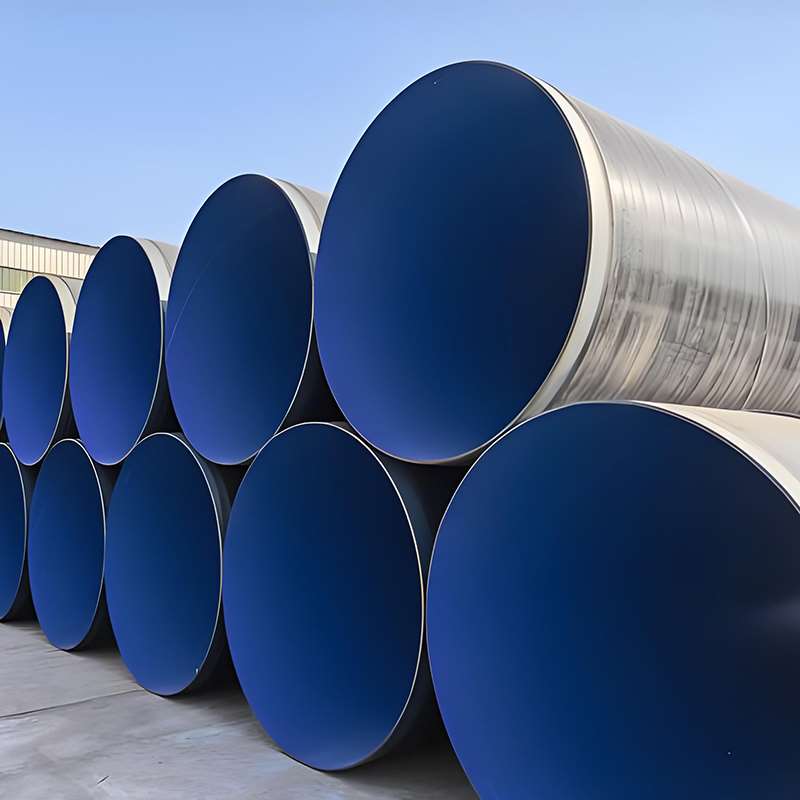
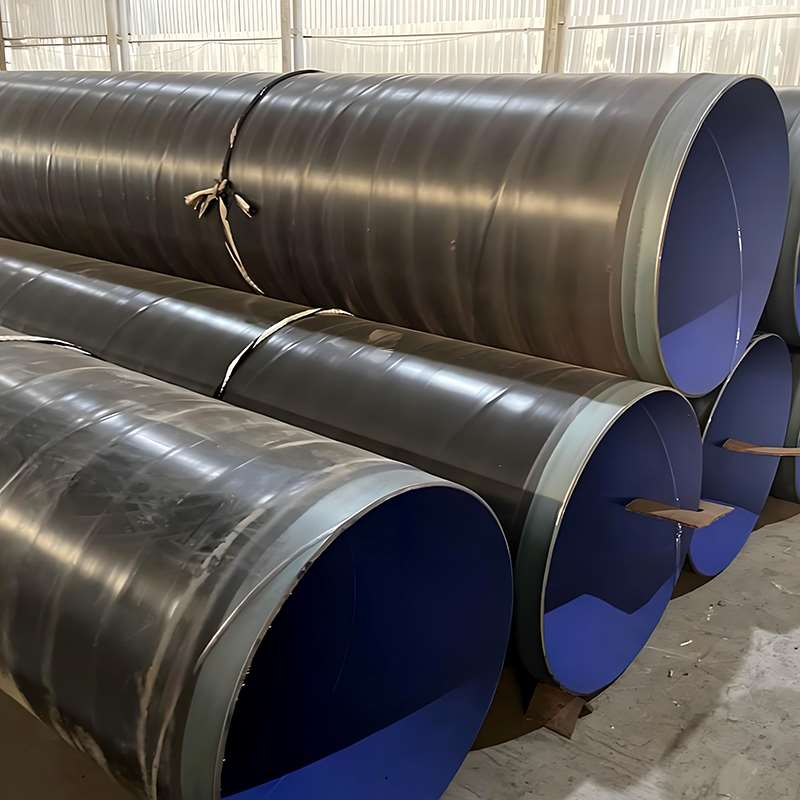
A complete anti-corrosion pipeline is an art form in which the base pipe and the coating bond at the molecular level. The physical properties of spiral welded steel pipes during manufacturing and transportation naturally align with the requirements of modern, fully automated anti-corrosion coating lines.
Continuous Rotational Motion: Whether using the 3PE or TPEP process, the spraying of the anti-corrosion coating and the wrapping of the polyethylene film require the pipe body to be subjected to uniform force. Spiral-welded steel pipes naturally exhibit this continuous rotational motion on the anti-corrosion production line, allowing the underlying epoxy powder (FBE) and the outer protective layer to cover the pipe body with uniform thickness, thereby preventing defects such as localized over-thickness or under-thickness.
No Prominent “Step Seams”: Traditional large-diameter long-seam submerged arc welded (LSAW) pipes feature a prominent, straight weld seam. When anti-corrosion rollers pass over this seam, “blisters” or coating edge thinning can easily form on both sides of the weld. In contrast, the weld seam on spiral-welded steel pipes is gentle and distributed in a circular spiral pattern. As the pipe passes through the anti-corrosion extrusion rollers, it is subjected to uniform force, thereby avoiding the corrosion risks associated with the “edge effect” of the coating.
III. Doing the Math: Cost-Effective Custom Solutions for Large-Diameter Applications
For B2B buyers and project owners, budget control is just as important as safety. Especially in large-scale water or gas transmission projects where pipe diameters exceed DN600 (particularly those above DN1000), spiral welded steel pipes demonstrate an overwhelming cost advantage.
Large-Diameter Pipes from Narrow Steel Strips: The manufacturing process for spiral welded steel pipes is highly flexible; by adjusting the forming angle, pipes of various large diameters can be produced from coiled steel of the same width.
Significantly Reducing Procurement Budgets: Compared to straight-seam submerged-arc welded pipes—which involve complex processes and require massive capital investment in equipment—selecting spiral welded steel pipes as the corrosion-resistant base pipe can reduce the initial procurement cost of piping for the entire pipeline by 20%–40%.
IV. Geometric Accuracy: Reducing the Failure Rate of On-Site “Joint Repair”
In actual construction, the roundness and straightness of the pipes directly affect the efficiency of butt welding at field sites.
Modern double-sided submerged arc welding for spiral-welded pipes can control pipe end dimensional tolerances within an extremely narrow range. Superior geometric accuracy means that high-precision butt welding between pipes is easier to achieve even in harsh construction environments, such as remote areas or sites with strong winds and sandstorms. A uniform weld gap ensures high-quality on-site welding; in turn, high-quality welding directly reduces the probability of “on-site anti-corrosion joint repair failures” caused by surface irregularities.
Key Technical Specifications for High-Value Procurement of Anti-Corrosion Base Pipes
Blasting Grade: Before entering the anti-corrosion coating process, the surface blast cleaning grade of the base pipe must strictly meet Sa 2.5 or higher; this is an ironclad rule to prevent coating delamination.
Weld Bead Height Control: During the production of anti-corrosion spiral steel pipes, the weld bead height of the base pipe used for 3PE/TPEP anti-corrosion coating must be strictly controlled. The weld bead height for both internal and external welds is typically required to be ≤2.5–3 mm to prevent damage to the anti-corrosion extrusion die and ensure uniform coating thickness.
Standard Compliance: For general water transmission or standard low-pressure applications, the SY/T 5037 standard must be followed; for high-pressure, high-demand oil and gas or critical pipelines, the GB/T 9711 or API 5L standards must be strictly adhered to.