
For SSAW steel pipes, the two mainstream coatings in the industry are 3PE (three-layer polyethylene) and FBE (fusion-bonded epoxy powder).
So, in complex underground environments, which coating is actually better and more practical? Below, we’ll provide an in-depth analysis based on structure, performance, and application scenarios.
I. Understanding the Two Core Technologies
To determine which is better, let’s first examine the underlying principles and structural differences between the two:
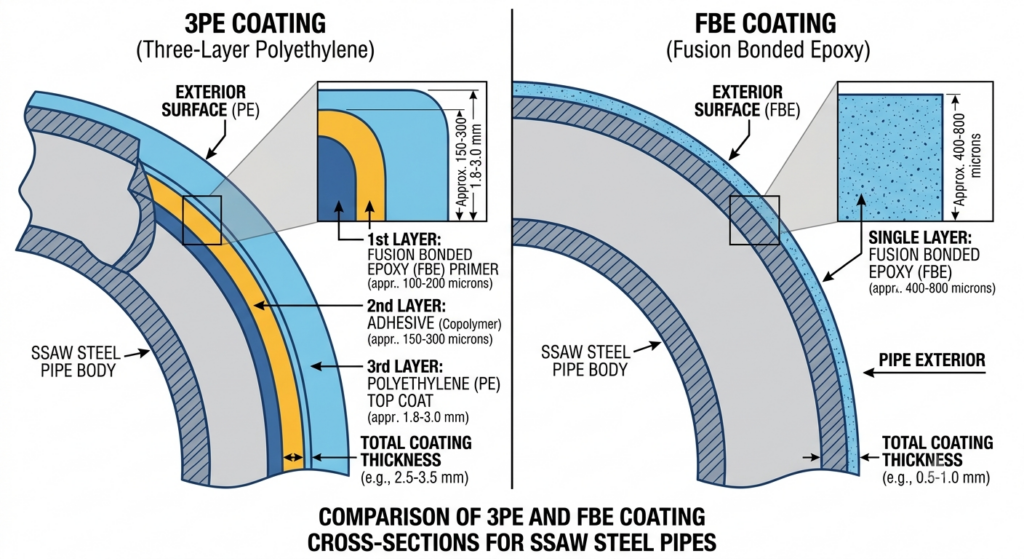
1. FBE (Fusion-Bonded Epoxy Powder)
- FBE is a single-layer corrosion protection system. It involves applying epoxy powder via high-pressure electrostatic spraying onto the surface of steel pipes heated to over 200°C, where it melts and cures into a hard, cross-linked structure.
- Features: Strong chemical adhesion to steel and excellent resistance to cathodic delamination.
2. 3PE (Three-Layer Polyethylene Composite Corrosion Protection)
As the name suggests, 3PE is a three-layer protective system that combines the advantages of epoxy resin and polyethylene:
- Base layer: FBE (epoxy powder), which adheres firmly to the steel pipe surface and provides chemical corrosion protection.
- Middle layer: A copolymer adhesive that firmly bonds the base layer to the outer layer.
- Outer layer: High-density polyethylene (HDPE), which provides protection against physical damage.
- Features: High mechanical strength, combining the adhesive strength of epoxy with the wear and impact resistance of plastic.
II. Performance Showdown: Which One Is More Hardcore?
| Performance Dimension | FBE (Fusion Bonded Epoxy) | 3PE (Three-Layer Polyethylene) | Winner |
|---|---|---|---|
| Mechanical Damage Resistance (Abrasion / Impact) | Relatively thin coating, more prone to scratches during transportation or backfilling with stones | Much thicker (typically ≥ 2.5 mm), excellent abrasion and impact resistance | 3PE dominates |
| Water Vapor Permeability Resistance | Long-term immersion may allow slight moisture vapor penetration | Polyethylene layer provides near-complete moisture barrier | 3PE wins |
| Cathodic Disbondment Resistance | Excellent performance; even if damaged, coating does not easily disbond over large areas | Good performance, but if outer layer is damaged and moisture enters, shielding/disbondment may occur | FBE wins |
| Temperature Resistance | Excellent (typically -30°C to 80°C, higher with modified systems) | Good, generally up to 70°C; may soften or creep under heat | FBE wins |
| Project Cost | Lower material and processing cost | Higher initial cost due to multi-layer structure and more complex manufacturing | FBE more cost-effective |
III. Which One Should You Choose for Underground Projects?
There is no absolute “which is better”; it’s a matter of “which is more suitable.” Based on the actual construction and operating conditions of underground pipeline networks, the following recommendations are provided:
III. Which One Should You Choose for Underground Projects?
There is no absolute “which is better”; it’s a matter of “which is more suitable.” Based on the actual construction and operating conditions of underground pipeline networks, the following recommendations are provided:
Scenarios where 3PE is recommended: Trunk lines with abundant rock, long spans, and complex geology
- The greatest threat to underground pipelines comes from hard rocks and gravel in the backfill soil, which can wear down the pipe body over time due to micro-movements of the earth’s crust.
- Long-distance oil and gas transmission trunk lines: The high-density polyethylene outer shell of 3PE acts like a layer of plastic armor, capable of withstanding rough hoisting, long-distance transport, and friction from backfill soil.
- Tunneling projects (such as shield tunneling, pipe jacking, and horizontal directional drilling): When pipes are forcibly dragged underground, only the thickness of 3PE can ensure that the anti-corrosion coating remains intact after the process.
Recommended Applications for FBE: Urban networks, high-temperature environments, directional drilling (minimally invasive), and related applications
- FBE is not a poor choice; its strengths lie in its “adhesion” and “resistance to peeling.”
- Pipelines operating at high temperatures: For example, heavy oil transmission or certain underground industrial pipelines carrying heat-generating media, where FBE offers superior stability at high temperatures compared to 3PE.
- Complex pipe fittings and joints: For SSAW steel pipe fittings such as tees and elbows, 3PE often struggles to provide complete coverage, whereas FBE can easily achieve all-around, gap-free corrosion protection through spraying.
- Areas with relatively uniform, soft soil: If the backfill soil is of good quality (consisting entirely of fine sand or soft soil) and the risk of mechanical damage is low, using FBE can significantly reduce initial project investment.
Summary and Purchasing Recommendations:
- If your underground pipeline will be buried in areas with complex geology, sandy or gravelly soil, requires long-distance hauling, or must cross obstacles, do not hesitate to choose 3PE SSAW steel pipes if your budget allows.
- If your pipeline has complex diameters, numerous elbows, operates at relatively high temperatures, and is buried in good-quality backfill soil, choosing FBE SSAW steel pipes can save you a significant amount of money while still providing excellent corrosion protection.
- When making a purchase, be sure to ask the supplier to provide coating thickness test reports and electric spark leak detection reports (3PE typically requires no breakdown at 25 kV) to ensure there are no pinholes. This is the key to truly extending the service life of underground pipelines.