
Many people believe that coated steel pipes are simply ordinary steel pipes with a layer of anti-corrosion material sprayed on the outside. In fact, the manufacturing process for a high-quality coated steel pipe is far more complex than one might imagine. From surface treatment of the steel pipe and coating application to final quality inspection, every step directly affects the product’s corrosion resistance and service life.
This article will take you through the process of how a high-quality coated steel pipe is manufactured.
Step 1: Inspection of Steel Pipe Raw Materials—The Starting Point of Quality Control
Any anti-corrosion product must be based on qualified steel pipes.
Before entering the anti-corrosion production line, manufacturers typically conduct a comprehensive inspection of the steel pipes, including:
- Whether the steel grade meets contractual requirements
- Whether the outer diameter, wall thickness, and length comply with standards
- Whether the weld seam appearance is smooth
- Whether there are surface defects such as cracks, pits, or folds
- Whether the pipe end bevel dimensions meet welding requirements
If the steel pipes themselves have quality issues, even the best anti-corrosion materials cannot guarantee long-term performance.
Therefore, high-quality anti-corrosion production begins with rigorous raw material inspection.
Step 2: Sandblasting for Rust Removal—A Critical Process That Determines Coating Lifespan
Many industry professionals believe that:
More than 70% of a coating’s service life depends on the quality of surface preparation.
This is because any oil, scale, rust, or dust will reduce the adhesion between the coating and the steel pipe.
Therefore, steel pipes must undergo sandblasting for rust removal before the actual coating application.
High-quality production typically requires the following:
- Surface cleanliness: Sa 2.5 grade (ISO 8501-1)
- Abatement depth: Approximately 50–100 μm
Sandblasting not only removes rust but, more importantly, creates a uniform, rough texture on the steel pipe surface. This provides excellent mechanical interlock for the subsequent coating, ensuring that the anti-corrosion layer adheres firmly to the pipe surface.
If the sandblasting quality does not meet standards, problems such as blistering, peeling, and delamination are likely to occur, even if the coating thickness is sufficient.
.jpg)
Step 3: Surface Cleaning and Preheating—Creating Conditions for Coating Adhesion
Once sandblasting is complete, the steel pipes cannot immediately proceed to the coating process.
Production personnel must also perform the following steps:
- Remove residual steel grit and dust
- Check for any signs of rust recurrence
- Measure the surface temperature of the steel pipes
- Control ambient humidity
- Preheat the steel pipes according to the specific process
For example, in the FBE (fusion-bonded epoxy powder) production process, steel pipes typically need to be heated to approximately 200°C so that the epoxy powder can melt rapidly and form a strong bond with the steel.
If the preheating temperature is too low, the powder will not melt sufficiently; if it is too high, it may adversely affect the performance of the epoxy material. Therefore, temperature control must be extremely precise.
Step 4: Coating Application—Different Corrosion Protection Systems Require Different Processes
After pretreatment is complete, the steel pipes enter the formal corrosion protection application phase.
Depending on project requirements, common corrosion protection systems primarily include the following types.
- FBE (Fused-Bonded Epoxy Powder Coating)
After high-temperature steel pipes undergo electrostatic spraying, the epoxy powder rapidly melts and cures, forming a continuous, dense anti-corrosion layer on the pipe surface.
FBE offers excellent adhesion, chemical corrosion resistance, and compatibility with cathodic protection, making it widely used in oil, natural gas, and water transmission pipelines.
- 3PE (Three-Layer Polyethylene Coating)
3PE consists of two additional layers applied over the FBE base, including:
- First layer: FBE epoxy powder (provides adhesion and corrosion resistance)
- Second layer: Copolymer adhesive (binds the layers together)
- Third layer: Polyethylene protective layer (provides mechanical protection)
The three layers are laminated in a single pass on a continuous production line, significantly enhancing impact resistance, wear resistance, and corrosion resistance. It is currently one of the most widely used corrosion protection systems for long-distance buried pipelines.
- Internal Corrosion-Resistant Coatings
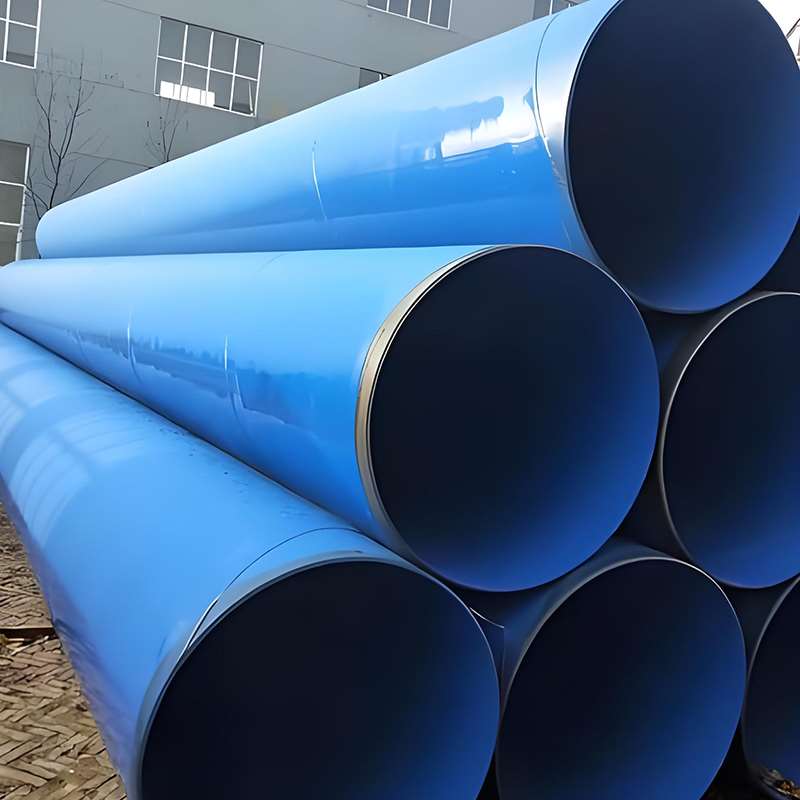
For steel pipes transporting drinking water, wastewater, or chemical media, the interior is typically lined with liquid epoxy, solvent-free epoxy, or cement mortar to reduce corrosion from the transported media and improve transport efficiency.
Step 5: Coating Curing—Forming a Stable Anti-Corrosion Protective Layer
Once the coating application is complete, the coating does not immediately achieve its optimal performance.
Depending on the material, the production line employs either natural cooling or controlled cooling processes to allow the coating to gradually complete its curing reaction.
Only after thorough curing can the coating achieve:
- Good adhesion
- Sufficient mechanical strength
- Excellent wear resistance
- Stable chemical corrosion resistance
If the curing time is insufficient, the coating may appear normal but is prone to cracking, chalking, or delamination during long-term use.
Step 6: Comprehensive Quality Inspection—Every Production Step Has Its Own Inspection Standards
Truly high-quality coated steel pipes are not shipped immediately upon completion of production; instead, they must undergo a series of rigorous inspections.
Common inspection items include:
Coating Thickness Inspection
A professional thickness gauge is used to measure dry film thickness (DFT) to ensure compliance with design requirements.
Electrospark Leak Detection (Holiday Test)
High-voltage electrospark equipment is used to detect pinholes, cracks, or areas with missed coating—a critical inspection item for long-distance transmission pipelines.
Adhesion Testing
The bond strength between the coating and the steel pipe is tested through peel or pull-off tests.
Visual Inspection
Inspect for the presence of:
- Bubbles
- Sagging
- Cracks
- Scratches
- Missed coating areas
- Color variations
Dimensional Inspection
Verify:
- Outer diameter
- Wall thickness
- Length
- Pipe end stub
- Bevel dimensions
Only after all inspection items have passed can the product proceed to the packaging process.
Step 7: Packaging and Transport Protection—The Final Line of Quality Assurance
Many people believe that quality control ends once a product leaves the factory.
In reality, a significant amount of coating damage occurs during transportation.
To prevent mechanical damage caused by ocean transport and lifting operations, high-quality manufacturers typically take the following measures:
- Install plastic protective caps on pipe ends
- Use rubber spacers or wooden dividers between pipes
- Use nylon slings for lifting to prevent direct contact between steel wire ropes and the coating
- Design appropriate securing and lashing plans based on the mode of transport
Proper packaging not only protects the integrity of the coating but also reduces maintenance costs prior to on-site installation.
Why Are Rigorous Manufacturing Processes So Important?
For underground water, oil, natural gas, and chemical pipelines, it is the steel pipe itself that truly needs protection.
If the anti-corrosion coating develops pinholes, cracks, or localized peeling, moisture, oxygen, and corrosive agents will rapidly come into contact with the steel, triggering corrosion that may gradually spread throughout the entire pipeline.
Therefore, the core value of a high-quality coated steel pipe lies not merely in having a sufficiently thick coating, but in establishing a rigorous quality control system at every stage of the manufacturing process. From steel pipe inspection, sandblasting for rust removal, surface pretreatment, and coating application, to curing, testing, packaging, and transportation—every step determines the product’s ultimate performance and service life.