
In underground or offshore engineering projects, large-diameter spiral-welded steel pipes are commonly used to transport water, oil, or natural gas. Due to the complex soil and geological conditions encountered by long-distance pipelines, these steel pipes are constantly at risk of electrochemical corrosion.
A corrosion protection system that can truly ensure a pipeline’s operation for more than 50 years is by no means simply “painting” the steel pipes. Modern pipeline corrosion protection is a microscopic scientific system combining “passive shielding and active defense.” The following explains how this system works in tandem:
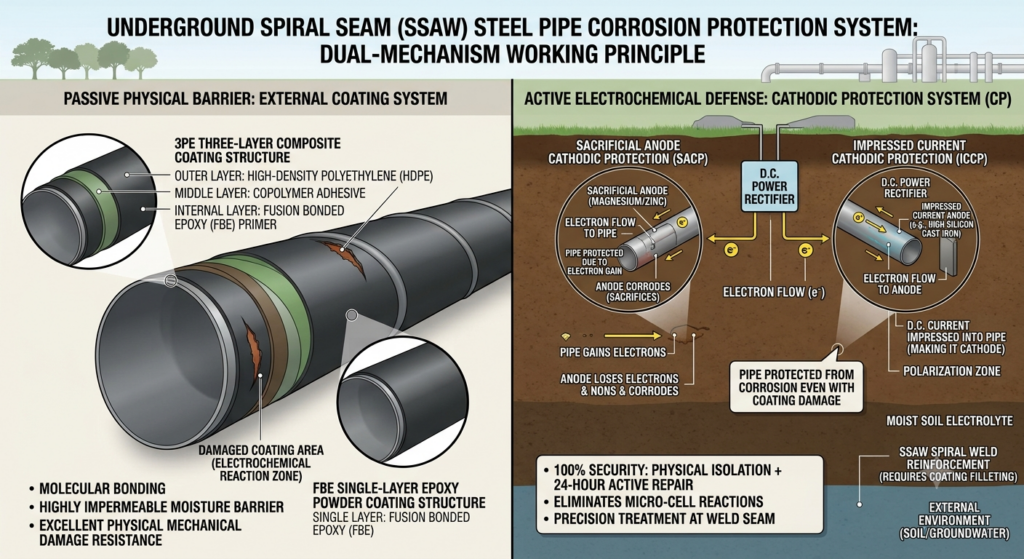
Principle 1: Physical Shielding of the Material (Isolating Water and Oxygen)
Corrosion is essentially an electrochemical process in which iron atoms lose electrons and become iron ions. This process requires three elements: steel (anode/cathode), oxygen, and an electrolyte (moisture in the soil).
Physical anti-corrosion coatings (such as epoxy powder [FBE] or liquid epoxy coatings) work by disrupting these three elements of corrosion and breaking the circuit of the microcell reaction:
- Molecular-Level Bonding: The coating melts at a specific temperature and cures on the surface of the steel pipe; its functional groups form extremely strong physical and chemical bonds with the iron atoms on the pipe’s surface.
- High-Density Barrier: A high-quality anti-corrosion coating has an extremely high molecular density, acting as a “water barrier” that prevents water molecules, oxygen, and corrosive ions in the soil from penetrating and coming into contact with the steel surface.
- Elimination of Microbatteries: Without an electrolyte (moisture), the local anodes and cathodes on the steel pipe’s surface cannot generate an electric current, thereby fundamentally preventing rust.
Principle 2: Active Electrochemical Defense (Cathodic Protection Mechanism)
No matter how perfect a coating may be, it is inevitable that microscopic pinholes or localized scratches will form during transportation over several kilometers, hoisting, and backfilling with underground gravel. Once a leak occurs, moisture immediately rushes in and causes severe localized corrosion on the exposed steel.
To apply an “invisible patch” to these vulnerabilities, engineers have introduced cathodic protection technology. Its operating principle is as follows: by continuously injecting electrons into the steel pipe through external means, the potential of the entire pipe is lowered, forcibly suppressing it within the “cathodic region” of the electrochemical reaction. Since the cathode only accepts electrons and does not lose them, the steel pipe will never rust.
In practical engineering applications, electron injection is primarily achieved through the following two mechanisms:
1. Sacrificial Anode Method
- Mechanism: Metals with a more negative potential and higher reactivity (such as magnesium, aluminum, or zinc) are connected to the spiral steel pipe via wires and buried underground together.
- Microscopic Process: At this point, the active metal and the steel pipe form a macroscopic “galvanic cell.” The active metal acts as the “anode,” actively releasing electrons and undergoing corrosion itself, while the electrons flow along the wire into the steel pipe (the cathode). The steel exposed at the leak point receives a sufficient supply of electrons, thereby preventing corrosion.
2. Imposed Current Method
- Mechanism: An external direct current (DC) power source is introduced. The negative terminal of the power source is connected to the coated spiral steel pipe, and the positive terminal is connected to an insoluble auxiliary anode buried underground.
- Micro-level Process: The DC power source acts like an “electron pump,” forcibly pushing electrons into the steel pipe. Current flows from the auxiliary anode through the soil medium into the steel pipe, enabling comprehensive cathodic polarization of the entire pipeline. This method offers a long protection range and is manually adjustable, making it the backbone of long-distance trunk pipelines.
Principle 3: The Special Corrosion Protection Mechanism at Spiral Welds
Spiral welded steel pipes are manufactured by spirally rolling and welding steel strips. Compared to straight-seam pipes, their welds are distributed in a spiral pattern along the pipe body, and the welds have a certain amount of weld bead height.
This unique geometric structure imposes more stringent microscopic requirements on the corrosion protection system:
- Mechanical Anchoring Effect: Prior to coating application, the steel pipe must undergo shot blasting to achieve Sa 2.5 grade. This is not only to remove weld slag but also to create microscopic irregularities on the surfaces of the weld and the pipe body (anchor pattern depth is typically required to be 40–100 micrometers). When the coating material melts, it penetrates these micro-pores, and upon curing, it forms a mechanical anchoring force similar to “tree roots gripping the ground.”
- Eliminating Edge Stress Shielding: The angles on either side of the weld are most prone to air accumulation, which can cause the coating to become suspended. A high-quality anti-corrosion process utilizes self-leveling or roller compaction techniques during spraying to ensure the anti-corrosion material completely fills the microscopic transition zones at the weld edges, preventing moisture from accumulating in hard-to-reach areas of the weld and triggering hidden crevice corrosion.
Practical Advice for Procurement and Engineering Personnel:
Once you understand these principles, you’ll realize—when conducting inspections or managing projects—that the “rust removal grade” determines how tightly the physical shielding can be applied, “electrical spark testing” reveals how many gaps there are in the physical shielding, and the data from “cathodic protection test piles” determines whether the active protection system is functioning properly. These three elements are interlinked and equally essential.