
Buried water supply pipes are constantly surrounded by soil, groundwater, and plant roots, while also being subjected to internal erosion and corrosion from water flow. If the wrong anti-corrosion coating is selected, the pipes are prone to perforation and leakage, which not only wastes water resources but also results in high excavation and repair costs.
Therefore, it is crucial to select an anti-corrosion coating that is “both cost-effective and durable” based on the pipe material, operating environment, and project budget. This article will provide you with a practical selection guide based on three dimensions: technical performance, application scenarios, and selection strategies.
I. Corrosion Protection Requirements for Buried Water Pipes
Before selecting a coating, we must first clarify the mandatory requirements that the buried environment places on the corrosion-resistant layer:
- Water Insulation: Blocking the erosion of steel pipe surfaces caused by moisture, stray currents, and microorganisms in the soil.
- Mechanical Strength: Buried pipes are subjected to compression and friction from rocks during backfilling and soil settlement; the coating must be scratch-resistant and impact-resistant.
- Resistance to Cathodic Disbonding: Modern buried pipes are typically used in conjunction with cathodic protection systems; the coating must be compatible with cathodic protection and prevent disbonding.
II. Analysis of Mainstream Anti-Corrosion Coatings for Buried Pipelines
Depending on the type of steel pipe and operating environment, the industry currently employs the following primary anti-corrosion solutions:
1. 3PE Anti-Corrosion Coating
This is currently the most widely used anti-corrosion technology for buried steel pipelines worldwide. It combines the strong adhesion of epoxy powder with the weather resistance and mechanical protection of polyethylene.
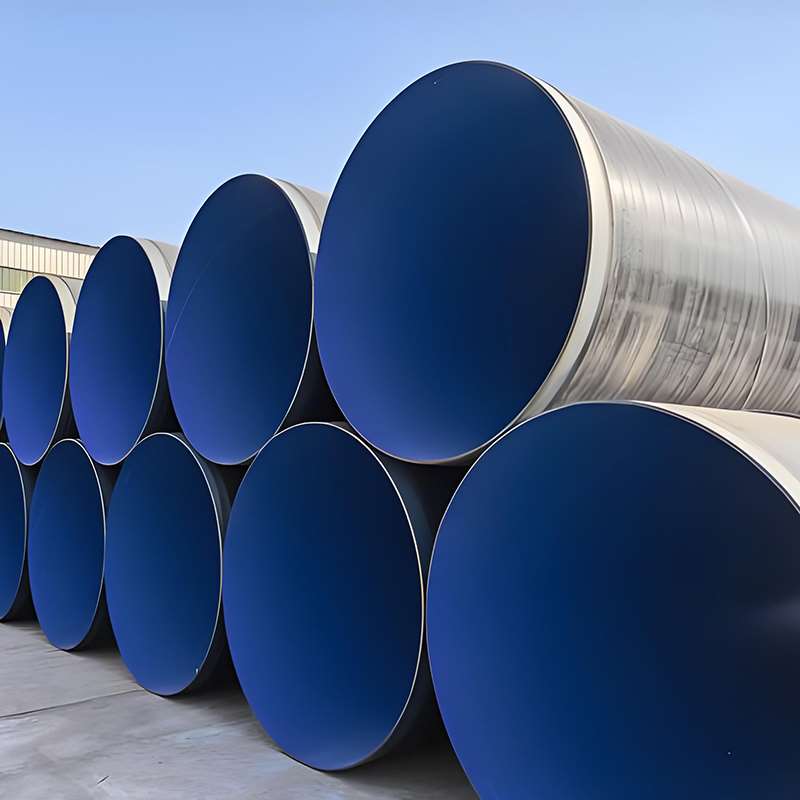
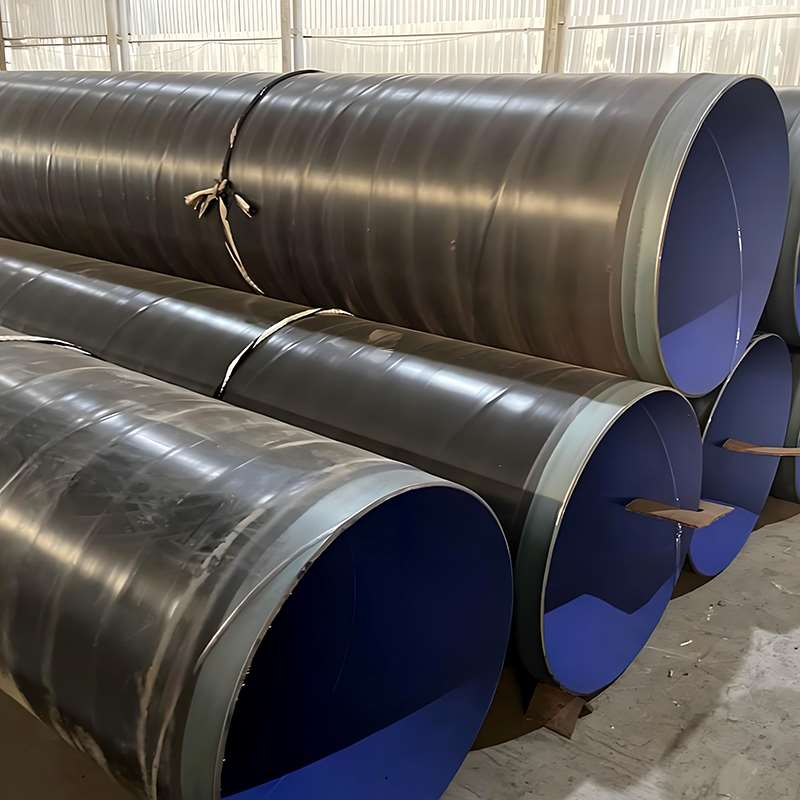
Application Example: In long-distance, high-pressure water transmission trunk lines, API 5L X42 3PE-coated spiral steel pipes—thanks to their high-grade steel toughness and top-tier protective coating—have become the preferred choice for interregional water diversion projects and urban water supply trunk networks. They can withstand extremely high soil loads and have a service life of over 50 years.
2. Epoxy Coal Tar Anti-Corrosion Coating
As a traditional anti-corrosion coating, it consists of a combination of epoxy resin, coal tar pitch, and glass fiber cloth (commonly known as “X layers of cloth and X coats of resin”).
Features: Lower cost and good water resistance.
Limitations: Long construction cycle, less environmentally friendly, and lower mechanical strength than polyethylene after curing. Its use in large-scale trunk lines is gradually decreasing, and it is now primarily used in small- and medium-sized municipal pipeline networks.
3. TPEP Corrosion Protection
The outer wall uses 3PE corrosion protection, while the inner wall uses melt-crystallized epoxy powder. This “comprehensive” solution addresses both the hygiene requirements for water transport on the inner wall and the need for soil corrosion protection on the outer wall. It features low hydraulic resistance and prevents scaling, ensuring the quality of drinking water delivery.
III. Steps for Selecting Corrosion-Resistant Coatings for Buried Water Pipes
Step 1: Assess Soil Corrosiveness and Topography
- Ordinary soil/sandy soil: Low risk of mechanical damage; a wide range of options is available.
- Mountainous Areas with Abundant Rock/Gravel: Pipe walls are highly susceptible to scratches during backfilling; a corrosion protection solution with high mechanical strength must be selected. In such cases, using high-quality coated spiral steel pipes can significantly reduce the construction damage rate.
- Swampy/Highly Saline-Alkaline Areas: Low soil resistivity leads to severe electrochemical corrosion; the use of 3PE or TPEP in conjunction with cathodic protection is mandatory.
Step 2: Define the Pipeline’s Operating Parameters
- High-pressure/large-diameter trunk lines: Pipes are subjected to high deformation stresses, placing stringent demands on the tear resistance of both the steel pipe itself and the coating. High-standard pipes such as API 5L with 3PE corrosion protection should be prioritized.
- Low-pressure/distribution branch lines: For smaller diameters and lower pressures, cost-effective corrosion-resistant coatings may be selected—provided they meet sanitary standards—to control the project’s overall budget.
Step 3: Comprehensively Consider Total Life Cycle Costs
- The initial investment in the anti-corrosion coating often accounts for only a small portion of the total pipeline cost; however, if excavation and repair are required due to coating failure, the subsequent maintenance costs are often several times higher than the initial investment. Therefore, “prioritizing upfront investment to reduce future maintenance” is the core principle of buried pipeline projects.