
As the “lifeline” of modern urban and industrial infrastructure, underground pipeline systems play a vital role in transporting oil, natural gas, tap water, wastewater, and various chemical media.
With the continuous expansion of project scale, large-diameter coated spiral steel pipes are being used more and more extensively in the construction of underground pipeline networks. These pipes not only possess high-pressure load-bearing capacity and mechanical strength but also, through anti-corrosion coating technology, address the challenges faced by traditional steel pipes—such as susceptibility to corrosion and short service life—in complex geological environments.
I. Corrosion Challenges Facing Large-Diameter Underground Pipelines
The underground environment is complex; the outer walls of pipelines are in prolonged contact with soil, groundwater, and acidic, alkaline, and saline chemicals, and may also be subject to electrochemical corrosion caused by stray currents as well as microbial corrosion.
- Soil Electrochemical Corrosion: Soil resistivity, pH, and oxygen content vary greatly from region to region, making it easy for microcell effects to form, which can lead to localized perforations in the pipe walls.
- Physical Stresses and Loads: Underground pipelines must withstand the gravitational load of overlying soil, dynamic loads from surface traffic, and tensile or shear stresses caused by geological settlement.
- Internal Corrosion from Transported Media: If the inner walls lack effective protection, long-term erosion from water flow or immersion in acidic media can also cause the pipe walls to thin.
Without scientific corrosion prevention measures, pipelines often develop perforations and leaks within a few years of commissioning, leading to major safety incidents and economic losses.
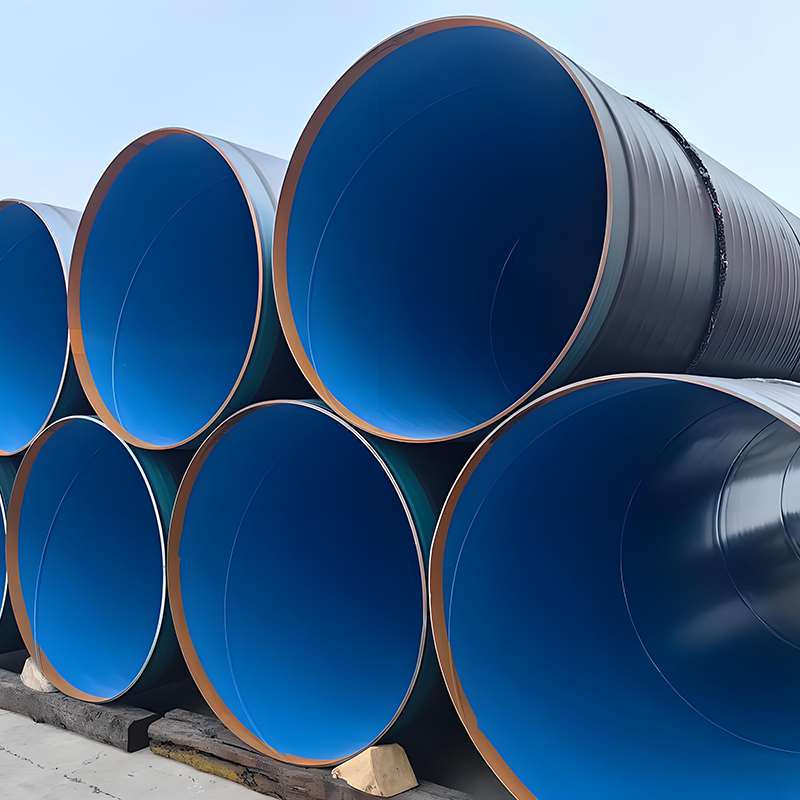
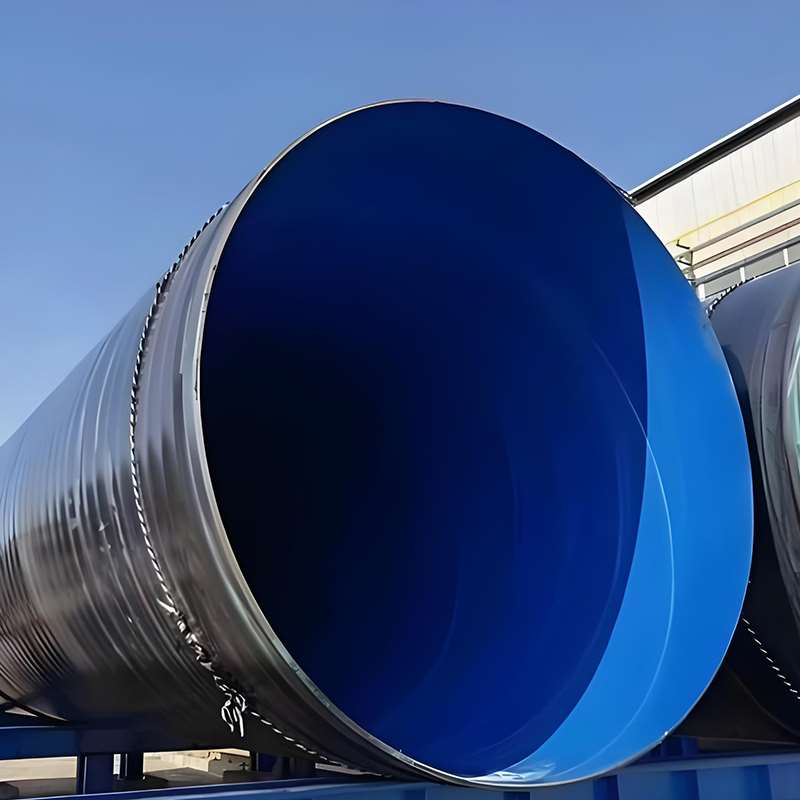
II. Selection of Pipe Materials: Structural Advantages of Corrosion-Resistant Spiral-Welded Steel Pipes
In large-diameter (typically referring to pipe diameters greater than DN500) underground pipeline projects, corrosion-resistant spiral-welded steel pipes are among the most ideal base material choices.
- High Structural Strength and Excellent Pressure-Bearing Performance
Spiral welded steel pipes are manufactured using hot-rolled steel strips as raw material through continuous spiral forming and double-sided submerged arc welding technology. Their weld seams are arranged in a spiral pattern, and the tangential stress generated when subjected to internal pressure is only 60%–75% that of straight-seam pipes, making them highly suitable for the construction of large-diameter, high-pressure long-distance transmission pipelines. - Flexible Specifications and Strong Customization Capabilities
Compared to straight-seam steel pipes of the same diameter, spiral-welded steel pipes can produce larger-diameter pipes using narrower steel strips, and the pipe length can be flexibly cut to meet on-site construction requirements, effectively reducing the number of welded joints required at the construction site. - Excellent Substrate for Coating Adhesion
After rigorous sandblasting and rust removal, the surface of corrosion-resistant spiral-welded steel pipes develops an appropriate anchor pattern depth, providing excellent physical adhesion for subsequent anti-corrosion coatings.
III. Mainstream Corrosion Protection Technologies: The Protection Mechanism of Underground 3PE Corrosion-Resistant Steel Pipes
Given the complex corrosive environment underground, underground 3PE corrosion-resistant steel pipes are currently recognized both internationally and domestically as having superior comprehensive performance and a wide range of applications.
The term “3PE” refers to a three-layer polyethylene corrosion-resistant coating, which ingeniously combines the excellent adhesion of epoxy powder with the strong chemical corrosion resistance of polyethylene.
- Base Layer (Fused-Bonded Epoxy Powder, FBE): Applied directly to the steel pipe surface, typically with a thickness greater than 80 μm. It possesses strong adhesion to metal, as well as resistance to cathodic delamination and chemical corrosion.
- Middle Layer (Adhesive, AD): Composed primarily of a copolymer adhesive, it serves as a critical transitional layer, tightly bonding the polar epoxy powder to the non-polar polyethylene.
- Outer Layer (High-Density Polyethylene, PE): The thickness typically ranges from 1.6 mm to 3.7 mm. Polyethylene features a very low water absorption rate, excellent resistance to soil stress, high abrasion resistance, and strong protection against mechanical impact.
This three-in-one composite structure enables underground 3PE anti-corrosion steel pipes to not only block water vapor and corrosive media but also withstand mechanical damage during excavation and backfilling. Their design service life typically exceeds 50 years.
IV. Key Construction Considerations and Application Areas
Large-diameter coated steel pipes require end-to-end quality control from production through to underground installation:
- Corrosion Protection at Joints: After on-site welding of the pipeline is completed, the corrosion protection at the joint welds is the weakest link in the overall protection system. Typically, radiation-crosslinked polyethylene heat-shrink sleeves (or tapes) or solvent-free liquid epoxy joint coatings are used to ensure that the corrosion protection grade at the joints matches that of the 3PE coating on the pipe body.
- Electrospark Testing: Before the pipeline is placed in the trench, 100% electrospark leak detection must be performed (the voltage is set according to the coating thickness; 3PE coatings are typically tested at 15 kV–25 kV) to ensure there are no defects or pinholes.
- Fine Soil Backfill and Cathodic Protection: When backfilling the pipeline trench, fine sand or fine soil must be laid first to prevent sharp stones from scratching the external protective coating; at the same time, impressed-current cathodic protection or sacrificial anode cathodic protection technology is employed to form a “coating + cathodic protection” dual barrier.
Main Application Scenarios:
- Long-distance Oil and Gas Pipelines: National energy corridors such as high-pressure natural gas trunk lines and long-distance crude oil pipelines.
- Urban Water Supply and Inter-basin Water Transfer Projects: Large-diameter water conveyance pipelines, such as supporting projects for the South-to-North Water Diversion Project and urban water supply trunk lines.
- Industrial and District Heating Networks: Corrosion-resistant outer casings for power plant circulating water pipelines, comprehensive utility tunnels in large chemical industrial parks, and district heating networks.