
When working on buried pipelines or water supply and drainage projects, you’ll often hear the terms “polyethylene coating” and “epoxy coating.” Although both are designed to prevent steel pipes from rusting and extend their service life, it’s as if you’re dressing the pipes in two different types of “protective gear”—each has its own unique characteristics and is best suited for different scenarios.
Choosing the wrong type of corrosion protection will either cost you more than necessary or lead to problems within just a few years after the pipes are buried. Today, we’ll explain in simple, easy-to-understand language exactly what the differences are between these two coatings and where each is best suited for use.
I. Their Respective “Characteristics”
To choose the right pipe, you must first understand the fundamental differences between these two materials:
- Polyethylene (PE) Coating: Like a “hard plastic shell,” it is impact-resistant and wear-resistant.
Polyethylene is inherently tough, wear-resistant, and impact-resistant, and it is not susceptible to acid or alkali corrosion in the soil.
Advantages: High mechanical strength and strong resistance to external damage. On construction sites, whether during pipe loading, unloading, dragging, or backfilling in rocky terrain, the polyethylene coating is unlikely to be scratched or damaged.
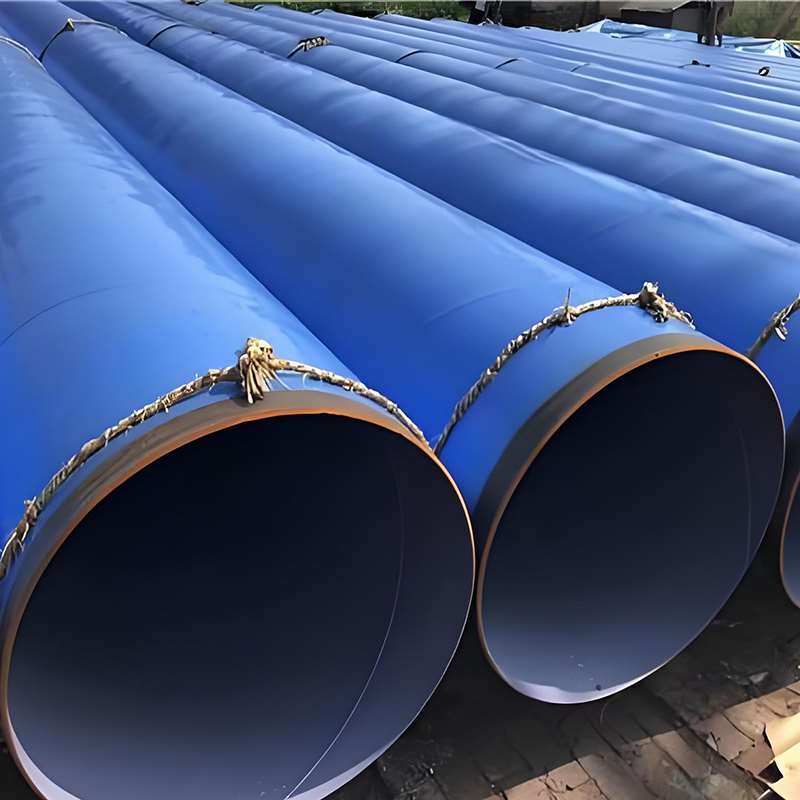
In actual engineering applications, a single-layer polyethylene coating lacks sufficient adhesion; therefore, the current industry standard is the “three-layer polyethylene structure” (commonly known as 3PE). For example, in long-distance, high-pressure cross-regional natural gas transmission trunk lines, API 5L X65 3PE-coated submerged-arc welded steel pipes are a typical example. The base layer uses high-strength API 5L X65 grade steel pipes, while the outer layer is protected by 3PE, enabling the pipe to withstand both internal high pressure and complex external soil environments. - Epoxy Coating (EP): Like a “ceramic lining,” it offers strong adhesion and a smooth inner wall
The most notable characteristics of epoxy resin are its “strong adhesion” and “smoothness.”
Advantages: High chemical adhesion and a smooth surface. Whether used for external corrosion protection or as an internal lining, it adheres tightly to the steel pipe surface and is not prone to peeling.
When used for internal corrosion protection, the epoxy coating reduces resistance to water or gas flow and is resistant to scaling, making it suitable for drinking water conveyance or water treatment systems.
.jpg)
II. Core Performance Showdown: What Are the Key Differences?
When comparing the two side by side, the main differences lie in the following areas:
| Comparison Criteria | Polyethylene Coating (Mainly 3PE) | Epoxy Coating (Mainly Single-Layer FBE or Liquid Epoxy) | Selection Recommendation |
|---|---|---|---|
| Resistance to Physical Impact | Excellent. The coating is relatively thick and highly resistant to damage from rocks and gravel during backfilling. | Moderate. The thin-film coating is more susceptible to scratches and damage during field installation. | Choose polyethylene coating for harsh ground conditions or demanding environments. |
| Adhesion & Peel Resistance | Good overall performance, relying on the underlying FBE layer for adhesion. | Excellent. Bonds directly to the steel surface with extremely strong adhesion and outstanding resistance to delamination. | Choose epoxy coating when maximum adhesion is the priority. |
| Heat & UV Resistance | Long-term exposure to sunlight can cause aging. Heat resistance is moderate (typically up to 70°C). | Better heat resistance than polyethylene, but prolonged UV exposure can lead to chalking and surface degradation. | Both coatings are primarily designed for buried pipelines and should not be exposed to long-term direct sunlight. |
| Application Cost | More complex coating structure, resulting in a relatively higher overall cost. | Simpler single-layer coating process with a relatively lower cost. | Select based on your budget and the expected service life of the pipeline. |
III. How to Choose Based on Pipe Body Structure in Actual Engineering Projects?
The selection of a corrosion-resistant coating cannot be separated from the steel pipe itself. In medium- to large-diameter projects, spiral submerged-arc welded steel pipes (SSAW) are widely used.
If you need large-diameter underground trunk pipelines:
In this scenario, corrosion-resistant SSAW steel pipes offer excellent value for money. Because spiral-welded pipes feature high production efficiency and large diameters, combined with 3PE corrosion protection on the outer wall, they are well-suited for long-distance transportation and installation in complex geological conditions.
If you prioritize the overall cost-effectiveness and construction adaptability of the pipeline:
In many municipal water supply and drainage trunk networks, the industry-standard practice for coated spiral-welded steel pipes is “polyethylene on the outside, epoxy on the inside”—that is, using 3PE polyethylene coating on the exterior to resist soil corrosion and compression, and an epoxy coating on the interior to ensure water quality safety and reduce hydraulic resistance. This “strong exterior, smooth interior” combination maximizes the advantages of both coatings.
IV. Practical Recommendations for Avoiding Pitfalls in Procurement and Construction
Determine the external corrosion protection based on on-site geological conditions: If the pipeline passes through deserts, rocky mountainous terrain, or saline-alkali soil with abundant groundwater, prioritize external polyethylene (3PE) corrosion protection; if the pipeline crosses fertile plains or sandy soil layers and site conditions are favorable, single- or double-layer epoxy powder coatings may also be considered.
Pay close attention to pipe end preparation and repair: Whether using polyethylene or epoxy coatings, a section of “bare pipe” must be left at the pipe ends during welding. The “repair” performed on-site after welding must use materials that match the original coating; if the repair quality is subpar, even the best corrosion-resistant steel pipes will be rendered ineffective.
Be sure to select an environmentally friendly grade for the internal anti-corrosion coating: If the pipeline is used to transport drinking water, the internal epoxy coating must be accompanied by a hygiene performance test report to ensure that no harmful substances leach out after the coating has cured.